Gratitude & Thankfulness: It’s a way of life!

Happy Thanksgiving, Boulder Families! On this day we think about what we are grateful for and share our blessings with others [If we are lucky and not just trying to get through the day because there are so many things to do and get ready]. I want to share with Boulder Families one of my favorite parenting guides/supports–The Daily Groove. This brilliant nugget of wisdom shows up magically in my In-Box every day. I read it–most days. I connect to it. I love the daily reminders to trust myself, listen to my instincts, relax, enjoy parenting, and honor my relationships. I will leave you today with a Daily Groove.

For a practical way of increasing gratitude check out my post on Thankfulness Trees.

:: A Post-Modern Thanksgiving ::

Transforming your life experience (including
parenting) from a *grind* to a *groove* leads
to a peculiar realization:

It’s all GOOD… even the “bad” stuff!

There are hidden blessings in *every* situation.
You may not see some of those blessings for quite
some time — perhaps years — but who’s to say you
can’t enjoy them before you know what they are?
Don’t you enjoy receiving a gift even before you’ve
unwrapped it? 🙂

So if you’re celebrating Thanksgiving today, try
giving thanks for things that don’t normally
garner your gratitude:

* Your child’s crying, whining, aggression, etc.

* The person who judged or criticized your
parenting.

* That thing you said or did to your child
that you promised you never would.

Allow yourself to appreciate that LIFE IS GOOD…
*all* of it! Acknowledge the gift of *shadows*,
without which the Light would have no depth.

Have fun!

http://dailygroove.net/thanksgiving

BVSD Open Enrollment Time Is Here!

Open Enrollment. These two words bring strong emotions to the parents of Boulder. For some who chose to enroll their kids in their neighborhood school, open enrollment in the Boulder Valley School District [BVSD] is not a big deal. Phew! For the 40% of us who do open enroll our children it can be stressful.

So what is open enrollment in BVSD? Any child can go to any school based on availability by entering their child into the lottery system called, Open Enrollment. All families in BVSD can look at all schools to see which one seems to meet their child[ren]’s needs best. There are many choices [charter schools, focus schools, and neighborhood schools] and each has it’s benefits and drawbacks. But ultimately many of us choose to open enroll our children to try and find the best fit. For more details on open enrollment click here.

There are two main types of BVSD schools:

1. Neighborhood Schools: These are the schools that are designated for your neighborhood. Your child can always get into these schools if you live within the boundaries. You DO NOT need to open enroll to these schools if you are in the neighborhood, but you CAN if you want your child to go to the school, but you are not in the designated boundary.

2. Focus/Charter Schools: These are open enrollment schools that serve ALL of BVSD. There are NO designated neighborhood boundaries for Focus and Charter schools. You MUST open enroll to these schools. 

To help you visualize the open enrollment process here is the BVDS open enrollment flow chart:

For Boulder Families with younger children there are a few schools that have open enrollment options for preschool, such as Community Montessori. For these schools, open enrolling at preschool age is the best way to secure a slot for your child. So even if your child is too young for elementary schools, taking a look at the open enrollment process can be really helpful.

Open enrollment happens for a limited time. You MUST apply to open enroll your child between November 26, 2012 and January 18, 2013. For more details on the dates click here. To get an open enrollment application head to the BVSD website starting November 26, 2012. Good luck to everyone open enrolling a child this year!

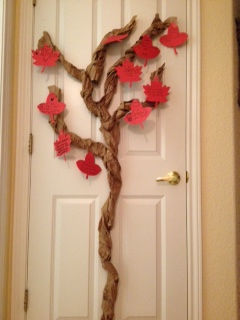
Thankful Tree: A Simple Way to Help Our Families Experience Gratitude

My friend offered a suggestion of how to increase gratitude in our families. I love it so much I need to share with all you Boulder Families! I posted recently about a lecture I attended on the Friends’ School Year Long Gratitude Project, but here I am again coming back to the concept. Maybe it is just that it is November and Thanksgiving is just around the corner. But it could just be that I so need the reminder to have gratitude. With all the amazing things in my life I still get overwhelmed and feel like the world is a heavy burden instead of seeing the joy in my life.  Here is a simple way to increase our gratitude on a regular basis: Create a Thankful Tree!

To create your Thankful/Grateful/Gratitude Tree you simply need to find a location in your home where you can put it up. This needs to be a sold vertical space. You need to find some brown paper [could be grocery bags, stuffing from a package, etc…], and twist it into a tree shape with branches and all. Then you cut out some leaves in whatever colors you like. My friend used the same colors, but varied the shapes. This is your creative process!

Then every evening the whole family can add something they are grateful for. In the beginning smaller children will have a tough time coming up with anything. Plan to do some role modeling until they get it. For small children they can draw instead of write or you can be their scribe. It does not matter how it gets on the leaves, it’s the gratitude that matters most.

Another friend took her kids [my son too] one morning to buy breakfast sandwiches and hand them out to the homeless people at the Boulder Public Library. It was a cool morning and at first the kids were nervous, but then they started in their own way to take part in sharing their bounty with others. They were able to see how a small act of kindness can go a long way. They were also able in the smallest way to see how much they have to be grateful for.

I would love to hear how your families offer gratitude and build it in as a value in your lives. It seems so important and yet at times tough to slow down enough to really feel gratitude deeply.

Small Business Saturday: Check out this promotion and save big!

American Express is holding their annual Small Business Saturday on November 24, 2012. Why should Boulder Families care? This is a really great opportunity to support local businesses, but it is also a fantastic way for families to save a lot! On November 24th when you spend at least $25 at participating local businesses using your American Express card you will get a $25 statement credit. This rocks!

There are a few things you need to do to get ready for this money saving event:

1. Register your Amex card[s] on November 18th. They say their is limited registration so I would actually get online and register as early on the 18th as possible. Don’t forget to register ALL of your cards with unique numbers because you can get the credit for each of these. For the registration site click here.

2. Research your favorite local stores to see if they will be participating. To do your research you can click here to see their Shop Small Map. You can search by city OR you can search by name. The name search may give you more than the general search.

3. Shop on 11/24. The best part is you support those stores because they keep the revenue, yet you get a credit. You have to spend at least $25. Consider spending on both of your cards to maximize your statement credit. Think of holiday gifts for teachers, family, friends, kids, neighbors or whomever you usually purchase gifts for. Also think about places you usually spend money for your family’s regular purchases. Maybe you can buy a gift card to this store for future purchases. Get creative. You get the idea!

The Mommy Points blog has a lot of detail on this promotion. I am telling you about it because I believe it is a great way to support small businesses AND earn some cash for your family at the same time.

Developmental Assets for Kids: What they are + how to develop them in your children

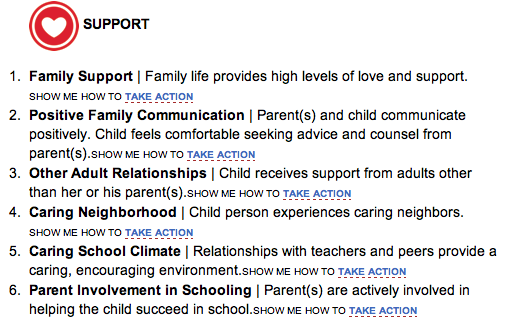
What are the assets our kids need to be happy and successful in life, school, work, relationships, etc…? The Search Institute has identified lists of building blocks of healthy development—known as Developmental Assets—that help young children grow up healthy, caring, and responsible. Below you will find a list of those developmental assets that are important for children at different ages. They carefully describe both children’s internal and external assets and give examples of how to develop these assets in our children.

Here is an example of the Support list for children ages 8 to 12. It includes both suggestions of important assets and how to take action to develop these skills/assets. They break them into categories of Support, Empowerment, Boundaries and Expectations, Constructive Use of Time, Commitment to Learning, Positive Values, Social Competencies, Positive Identity.

Site: Search Institute – Creators of The 40 Developmental Assets: Resources, trainings, downloads, etc. http://www.search-institute.org/

Raising Happiness: It’s easier than we think!

Friends’ School Photo

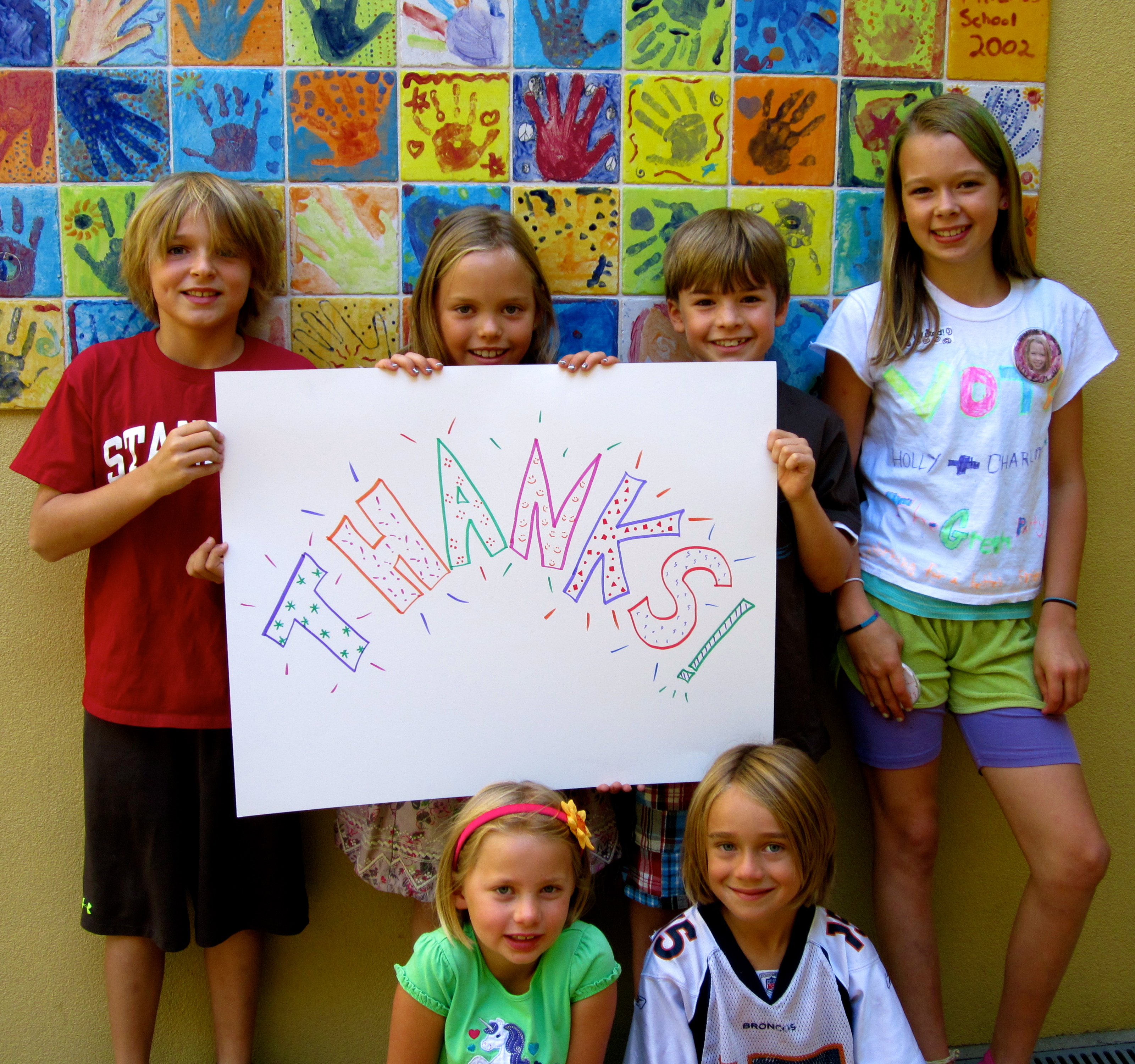
I have to let you know about a project a local private school, Friends’ School, has undertaken called, The Gratitude Project. They are spending the year learning about how gratitude impacts learning. I love this! On 10/18 they brought in well known speaker Christine Carter to speak about a topic near and dear to her heart, Raising Happiness. She literally talked about how we could raise happier children. I was excited! I needed the 411 on this badly!

Her first take home message was quit equating success with happiness! Success does not lead to happiness. We all know the very successful people who are NOT happy. Instead she proposes that happiness leads to success. Do what you love and the success will follow. At this point I took a deep breath and relaxed. I know this to be true. I know in my heart that this is the case yet I was always taught that success lead to happiness. I now know to help instill this in my children: Happiness Leads To Success!

Dr. Carter outlined the individual qualities that lead to success in life and school:

  • Social Intelligence [I think this is similar to Emotional Intelligence]
  • Gratitude
  • Optimism
  • Curiosity
  • Grit [also known as resilience]
  • Self-control
  • Zest

Can we help ourselves and our children embody these qualities? Yes, we can! It take practice, but as we increase gratitude by noticing and then expressing this value it will increase our sense of self-worth and happiness.

A few ideas of how to foster gratitude:

  • At the dinner table ask each family member to say one thing they are grateful for. Role model this one for best success. Even the smallest members of the family can participate.
  • Ask about kindness. What is one kind thing someone did for you today? What is one kind thing you did for someone today?
  • Help others. Sign up to help at a soup kitchen or bring food to the homeless. A call to the homeless shelter or EFAA can help you make plans to help others.

Maybe you have some additional ideas of practices in your family that help each of us to embody the values of gratitude & happiness. Let us know!

Children and Chores: What is appropriate?

I was inspired to write about this topic by a blog post I read, and my own struggles with keeping my house clean, to try and discuss this issue here on Boulder Families. We have a modest size house and I struggle to keep it clean. Up until recently I did everything for my kids. Really! I would bring in their backpacks from the car, clean up after them, make dinner, set the table, clean the table, etc… My husband was beside himself that I would rather let them finish the Really Important LEGO project they had going on than to ask them to set the table. Just easier to do it myself AND I felt that their play time was somewhat sacred. I wish I could pin point what made me switch my tune, but it happened and it was a shock to everyone.

I no longer feel it is all my responsibility, but I share it with my family. The kids set the table. They clean their room. They carry their backpacks into and out of the car daily. They bring me their lunch boxes if they want them refilled with lunch and snack for the next day. [I decided to forgo my husbands suggestion that I buy a Dora lunch box that I gave my boys if they forgot their lunch box at school–just too mean!] But it still amazes me when they willingly set the table or bring in their bags. It shouldn’t, but it does. It just took some consistency and setting an expectation and now it just happens. Magic!

Recently a friend told me about how her family has dedicated 2 hours on Saturday each week to cleaning. Everyone takes their own room and one other room and they get to work. They are teaching the kids to clean the bathroom, vacuum, clean the kitchen, etc… You don’t have to go to this extreme to have your kids involved in the household chores. But get them involved. They like to have responsibilities [after they stop complaining about doing the chore!]. I highly recommend asking kids to help make dinner. Have them plan a meal. Make a grocery list, go shopping, and make the food. It’s a big hit in our house!

My take aways from getting the kids involved in household chores: It takes the load off the parents; It allows the kids to feel ownership of the household; It bonds us through shared work; and it just feels right!

What are age appropriate chores? For this answer I am relying on a recent post from CrassParenting.com

Below is a sample of chores, by age, that children can do. You need to keep in mind that children mature at different rates so there is some wiggle room in these age guidelines.

2-3 years old

Kids at this age are often eager to help. At this age, you shouldn’t give a chore and walk away, but do the chore along with them. This helps teach them what a completed chore looks like.  Making it a game makes it a lot of fun too.

  • Pick up their toys
  • Put their dirty clothes in the hamper
  • Dust furniture
  • Hang up towel in bathroom after bath time
  • Fill pet’s food and water bowl with supervision

4-5 year olds

This is an age that can help out a lot more than we give them credit for. They are still eager to help out and are proud of their accomplishments. Praise at this age goes a long way into making this a good experience for your child.

  • Make their bed, especially if it is a simple quilt or comforter
  • Match clean socks after the laundry is completed
  • Empty small wastebaskets
  • Swiffer the floor
  • Help bring things from the car to the house
  • Help set and clear the table with assistance – especially with breakable items

6-7 year olds

This is an age where the kids can help out that really make a difference. Sadly, this is an age where the bad attitudes can start to creep in too. However, praise and appreciation go a long way into smoothing out those attitudes. Linking responsibility and a job well done to more grown up privileges can help too.

  • Make their lunch for school. Give them a variety of choices from which to choose, but make them choose at least one item from each food group. Don’t forget a little treat too!
  • Help fold clothes.
  • Begin choosing their own outfits and get dressed without supervision
  • Help with simple outdoor maintenance like weeding the garden
  • Vacuum their room
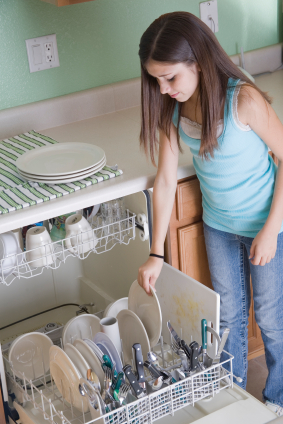
  • Put away dishes from dishwasher
  • Help bring garbage out
  • Help prepare meals being mindful of safety issues like knives. Measuring ingredients, stirring and tossing salads are good chores for this age.

8-11 year olds

This is the age where sport schedules and other non-school activities start to become crazy. Be sure to carve out some time each day and week for kids in this age group to help out. Don’t let their activities be an excuse not to have them help the family.

  • Begin doing their own laundry from time to time.
  • Help prepare meals. At this age, they should be capable of using a sharp knife safely.
  • Clean the kitchen after a family meal from start to finish.
  • Clean their bathroom from start to finish
  • Rake leaves
  • Wash the family car – a favorite chore in my house!

12-15 year olds

This is the time frame to teach the children more life-skill oriented chores. It is good to let them know that in addition to helping the family out, they are learning to do what they will be responsible for when they are adults.

  • Be responsible for getting themselves up in a timely manner each morning by using an alarm clock
  • Maintain personal items like recharging batteries to electronics
  • Changing their bed linens
  • Mow the lawn, with supervision
  • Prepare an occassional family meal
  • Babysit depending on state laws. Most states allow it at 12 years old
  • Help with all aspects of yard work,
  • Help with grocery shopping including preparing a list
  • Begin to start managing their own pocket money

16 years old and older

At this age, they should be able to do any household chore that you can do. This is also the age that school work ramps up tremendously along with after-school activities. Household chores should not be done at the expense of schoolwork as that is the child’s primary job. As a parent you may need to be a bit more flexible on when the chores get done to accommodate your child’s schedule. Be particularly flexible during school-intense periods like mid-terms and finals. At this age kids need to learn how to juggle everything that needs to get done in their lives and that goal should be kept in mind along with helping the family out.

Additional web resources:

What chores do your kids do?

Kids Halloween Costume Ideas

Halloween costume ideas for those of us who have not decided or pulled them together yet. What are your kids dressing up as? These are some cute ones…

Legos…


Thing 1 + Thing 2…


and Starwars…


You can find more costume ideas on my Pinterest site: http://pinterest.com/awember/halloween

Trip Review: Bike Riding With Kids Along South Boulder Creek Trail to Bobolink Trail

Yesterday we got out for a really fun bike ride with the kids along the South Boulder Creek Trail. I think this one is appropriate for most ages as long as your child is steady on dirt paths. The ride started at Marshal Road right off of Broadway heading South out of Boulder. There is plenty of parking along the road. The South Boulder Trail connects to the Bobolink Trail as it heads under South Boulder Road. Both trails are relatively flat, meandering at times, but generally perfect for most kids.

The ride started with both of my kids begrudgingly getting on bikes. But really as soon as they hit the trail they forgot about their initial feelings and cruised along. We headed out along the wide dirt path and meandered over bridges, under a road, along agricultural land with cattle, along South Boulder Creek and the beautiful trees lining the creek, & checked out some cute prairie dogs [kept our distance]. The kids had a great time! We stopped as often as we wanted along the creek for them to throw rocks, climb trees, or walk along the irrigation pipes. The whole path is a playground.

I will definitely be adding this trail to my Top 5 Bike Rides for Kids in Boulder!

Ride Details

Distance: 2 miles along South Boulder Creek Trail to the connection with Bobolink [out and back]. If you take the trail all the way to Bobolink Trailhead add 1.5 miles from the tunnel under South Boulder Road.

Difficulty: Easy to moderate [only because it is all on dirt trail, so some biking proficiency is helpful]

Website: Bobolink/South Boulder Creek Trails

#bike #Boulder #kids #trails #getoutdoors #Colorado

Reaching Your Child In a World of Distractions

This is a re-post of a recent blog from http://www.handsfreemama.com.  It is so poignant that I feel it needs to be spread far and wide and made available to as many families as possible. As the world opens to our children & technology creeps in in places you never suspected, the question remains loud and clear: How do we reach our children in a world full of distractions?

Thanks to Rachel of blog Hands Free Mama. She has been inspiring many people to make a shift and work on being present for their children. I am inspired by her. I hope you are too! Here it goes: 

At my very first “Hands Free” speaking engagement, a woman in attendance said her children were getting to the age where they just wanted to do their own thing. She felt that the older her children grew, the more difficult it was to find shared interests and spend time together.

Honestly, I didn’t know what to say. This concept of one’s children not being permanently attached to one’s side seemed completely foreign to me. I simply did not believe the day would come when I could use the restroom without a voyeur. I could not fathom the thought that my youngest child would one day resign from her duties as my fulltime bodyguard and actually let me out of her sight.

But here I am a year later and it’s happened. My daughters love to play together. And I am no longer needed nor invited. They set up the Barbie house and play for hours without any need for my creative storylines and juicy plot twists. They play school and inform me I am over the age limit to be a student. And when they log on to animaljam.com and starting talking gems, avatars, and dens, this technology-challenged parent might as well be invisible.

But I am all about being real in this space I call “Hands Free Mama,” so here’s some realness: When my kids are in their own little world, it’s quite tempting to go into mine. It’s tempting to pop open the laptop and knock out another chapter in my book, draft a new blog post, or even just pick up a delicious book I have been dying to read. While there is nothing wrong with any of these activities, nor is there anything wrong with my children playing by themselves, I can see how easy it would be to allow separate lives to become a way of life. I can see how easily the space between us could grow until the gap is so wide we can no longer reach one another.

What motivates me to get up from my keyboard and participate, even just as an observer in my children’s preferred activities, is the whole reason I started this “Hands Free” journey in the first place. I don’t want to look up at my children’s high school graduation ceremony and see a stranger walking across the stage.

It’s no secret that this type of parent-child estrangement can happen without warning. Furthermore, the realization that it has happened often comes too late. In fact, even before technology was a readily available distraction, many generations of parents have looked back on their child-rearing years and wish they had invested more time in their children’s lives.

This topic is addressed in a book entitled 30 Lessons for Living written by Karl Pillemer.  In this powerful book, Pillemer shares the priceless information he gleaned from older Americans—which he refers to as “experts” in the area of living an intentional, meaningful life. Interestingly, the elderly experts who didn’t have regret in this area had “creatively manufactured” shared time. This meant going along with their children’s interests whether the parent enjoyed these activities or not.

Pillemer shares this powerful observation: “The more I talked to the experts about child rearing, the clearer it became that the quality of relationships with the children is directly proportional to the amount of time spent together.”

I don’t need proof that spending time with my childrennow will likely result in a close relationship later, but it feels reassuring to know that the wisest Americans (through personal experience) confirm this theory to be true.

So here are the things I do … things that don’t come naturally to me … things I could easily take a pass on, but I don’t. I do these things—not because I enjoy them—but because someone very important to me does …

I hold the roly poly in my hand—not because I like how those creepy little feet feel on my nice clean hand—but because it feels good to slow down and marvel at a tiny miracle through my child’s eyes.

I go down the giant curly slide at the park—not because I like to hear my skin squeak as it sticks to metal—but because of the joyful laughter and grateful smiles that greet me at the bottom.

I read the American Girl chapter book out loud—not because it has a compelling plot and strong character development—but because of the way my child feels snuggled next to me as I read words she does not yet know.

I watch her lip-sync Taylor Swift music videos—not because I like to hear “We Are Never Ever Getting Back Together” ten bazillion times—but because the facial expression she makes are indescribable, and I want to remember them when I am 80-years-old.

I lay beside her when she’s worried about something—not because her bed is more comfortable than mine—but because after a few minutes, she whispers her fears into the dark, and I am there to comfort her.

I join her on the porch when she plays with the cat—not because I lack something more interesting to do—but because this is when she randomly throws out questions like, “What do you love about me?” and “What happens when we die?” And I want to be there to answer them if I can.

I strap on a pair of goggles and swim beside her—not because this is a good look for me—but because it allows me a close-up view of her proudest moment doing something she thought she’d never do.

I listen to her describe (in agonizing detail) how to create an iMovie using dolls—not because this topic interests me in the slightest—but because out of all the people in the world she could teach this to, she wants to teach me.

I sit on the porch and watch her do awkward handstands and clumsy cartwheels—not because this is riveting entertainment—but because I want my child to look back on her growing-up years and remember a mom that was present in the mundane, every day moments of life.

I make an effort to take an interest in my children’s preferred activities—not because their desires are more important than mine—but because I want to know them and I want them to know me … now and in the future.

Just knowing there are some elderly parents out there today wishing they could turn back time and make different choices about time spent with their kids is a wake-up call for me. After all, when those folks had young children, the digital distractions that parents deal with today were not prevalent. Yes, there were other distractions just like my parents and your parents had, but more and more research shows that mobile devices are more distracting and habit-forming than the diversions of yesteryear. In fact, the recent association of childhood injury and lack of parental attention due to “device distraction” is quite sobering.

We are the first generation of parents raising our children with the ever-present lure of technology at our fingertips. We are the first generation of parents able to be digitally connected to virtually anyone, anytime, anywhere. We are the first generation of parents who will show our children that technology is either a tool or a crutch—that it can enhance or damage our lives. Time spent engaging as a family does not come naturally anymore, yet time isolated from one another comes a little TOO naturally. In fact, time spent alone on our respective devices has become a way of life for many.

I’ve decided I am going to fight the natural inclination for separate interests, separate screens, and separate lives. Even if it means sometimes doing an activity I am not crazy about doing. Because when it comes down to it, my motivation is pretty simple:

I want to know what makes her smile.

I want to know what makes her laugh.

I want to know what makes her hurt.

I want to know what makes her dream.

I want to know what makes her proud.

I want to know what makes her tick.

And I cannot know these things if I am spending time in another room

Holding tightly to my distractions

Creating a world of emptiness between us.

Rachel’s mission is to provide individuals with the inspiration, motivation, and tools to let go of daily distractions so they can grasp the moments in life that matter. Join her on her journey to a more meaningful life at www.handsfreemama.com and by visiting “The Hands Free Revolution” on Facebook: https://facebook.com/TheHandsFreeRevolution